The shortage of skilled labor has long become a reality in industrial manufacturing. Experienced machine operators, application engineers, and process specialists are becoming scarce, while at the same time the demands for precision, quality, and delivery reliability continue to increase. Many companies are facing the challenge of maintaining complex processes with fewer specialized personnel. This is precisely where process-reliable and reproducible manufacturing solutions gain importance.
Why experiential knowledge becomes a bottleneck
In many production environments, quality depends heavily on the expertise of individual employees. Parameters are adjusted “by feel,” deviations are corrected intuitively, and problems are compensated through experience. When this knowledge is no longer available, processes begin to destabilize. New employees require long training periods, error rates increase, and dependence on specific individuals grows.
Process stability instead of dependency on individuals
Stable processes transfer knowledge from the operator’s experience into the machine itself. Reproducible cutting movements, defined parameters, and monitored process variables ensure consistent results—regardless of shift, operator, or daily conditions. The process becomes controllable—even with less experienced personnel.
Technology as a repository of knowledge
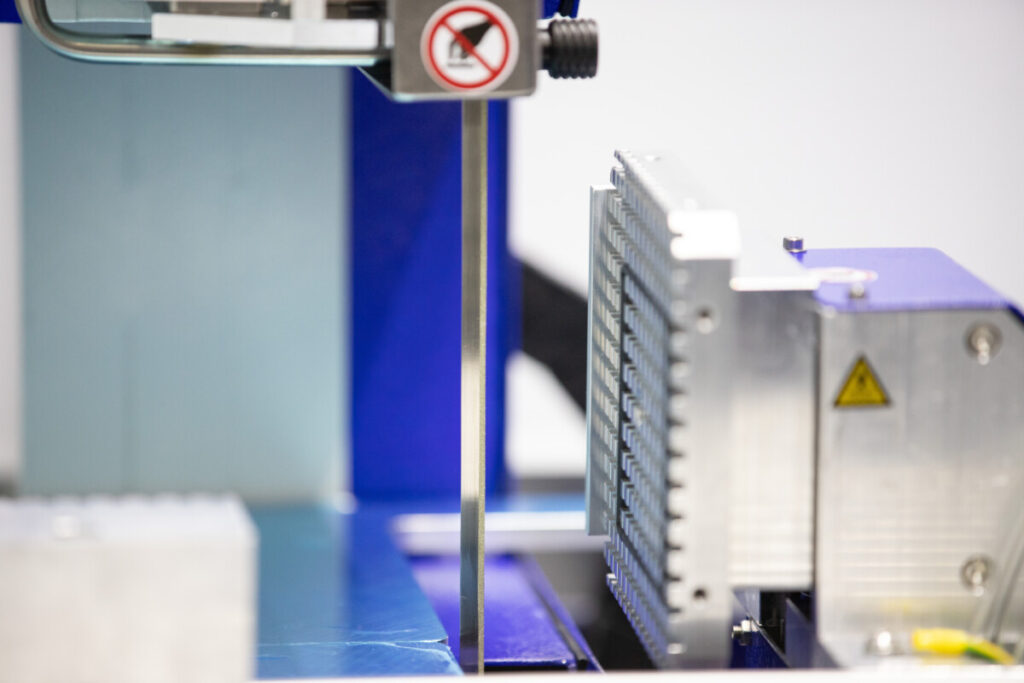
DRAMET diamond band saws support this approach through technical solutions that create stability and transparency. NC control systems enable precisely repeatable operations, while optional cutting force measurement provides objective feedback on process conditions. Deviations are detected at an early stage—before scrap occurs. In this way, experience is not replaced, but systematically supported and safeguarded.
Faster training, lower error rates
Clear and stable processes significantly simplify the onboarding of new employees. Instead of relying on complex experiential knowledge, defined procedures must be understood and applied. This reduces operating errors, lowers scrap rates, and relieves experienced specialists, allowing them to focus more on optimization and development.
Maintaining productivity despite labor shortages
Companies that stabilize their cutting processes safeguard productivity even under challenging staffing conditions. Less rework, fewer stoppages, and predictable results provide security in production planning. Especially when machining sensitive materials such as graphite, ceramics, or optical glass, this stability is essential to reliably meet quality standards and delivery deadlines.
Conclusion
The skilled labor shortage cannot be resolved in the short term—but process instability can. Companies that rely on stable, reproducible cutting processes reduce their dependence on individual expertise and make their production more resilient. With precise machine technology, intelligent process monitoring, and practical application support, DRAMET helps companies embed knowledge into processes—ensuring long-term competitiveness.
Contact us for a non-binding consultation on how stable cutting processes can make your production more resilient to skilled labor shortages.